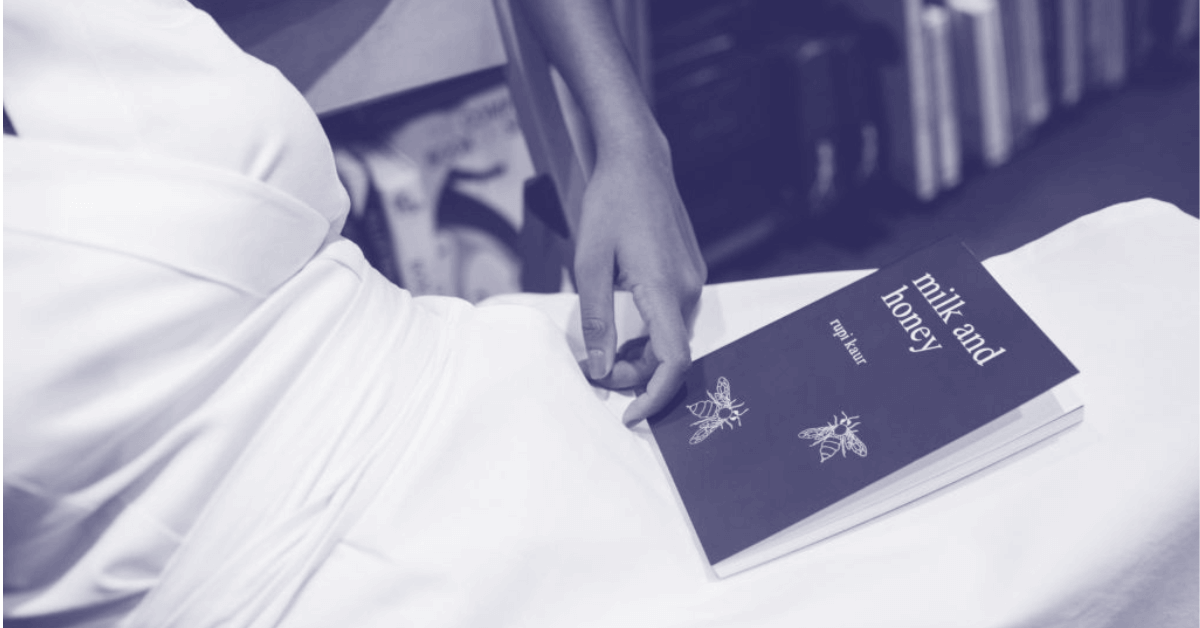
milk and honey is Rupi Kaur's first poetry collection, a book of short poems, prose pieces and line drawings about surviving violence, finding love, losing it and healing. This is our reader's guide to it: what's in its four chapters, what it's about, why it was loved and criticised in equal measure, and nine poems Kaur shared on Instagram that give you a feel for it before you pick it up.
Some books arrive at exactly the moment you need them. For a lot of readers, especially young women, milk and honey was that book, the first time poetry felt like it was talking to them rather than over their heads. Whether you're about to read it for the first time or coming back to it, we hope this helps you read it well.
What milk and honey is
Kaur wrote and illustrated the book while she was a university student in Canada. She'd tried sending single poems to literary journals and collected rejections, then realised the poems made more sense read together. So she edited and designed the book herself and self-published it in November 2014, and her family and friends hand-sold copies at local events.
Then Instagram happened. Kaur's audience grew fast, and in October 2015 Andrews McMeel Publishing released the edition most people own today. Her publisher now calls it a #1 New York Times bestseller with more than 7 million copies sold, translated into over 40 languages. A tenth-anniversary collector's edition followed in October 2024.
The four chapters
The book is organised into four sections, and it's meant to be read in order, start to finish. Each chapter works as one movement of a longer story.
- the hurting is about family, including growing up with an alcoholic parent, and about sexual abuse and assault. It's the hardest section to read, and it's where the book's later tenderness comes from.
- the loving lifts the mood. These are poems about desire and closeness, often playful and sensual, about learning what love can feel like.
- the breaking follows the end of a relationship: the leaving, the coming back, the grief and the self-doubt that come after.
- the healing turns to recovery and self-worth, and speaks directly to women about embracing who they are, whatever they've been through.
Read the chapter titles in a row and you have the whole arc in four words. That's worth noticing before you start, because the order is the point. The healing only lands because you've walked through the rest.
Themes and style
Her publisher sums up the book's subjects as violence, abuse, love, loss and femininity. Running underneath them all is a question about survival: how a person carries what's been done to her and still becomes soft enough to love.
The style is the famous part. Everything is in lowercase, and the period is the only punctuation, because Kaur writes in the spirit of Gurmukhi, the script of her first language, Punjabi, which has no capital letters and a single punctuation mark. She has called it an ode to her identity as a diasporic Punjabi Sikh woman.
Lines are short, breaks are pauses, and many poems close with an italic title that names who or what the poem is about. Her simple line drawings sit beside the words like a second voice.
Here's how to try it: pick any page, read it once for meaning and once just looking at where the lines break. The breaks tell you where she'd breathe if she were reading it to you.
Nine poems to start with
These are posts from Kaur's own Instagram. She has confirmed some as pages from the book; others she posted around the book's launch and anniversaries, so read them as companions to it.
The title image
Read this poem on Rupi Kaur's Instagram
This is the poem that seems to give the book its name. It ties the image of milk and honey to a surprising source of gentleness, and the last line is worth discovering for yourself. Kaur shared it with the caption "from milk and honey to rupi kaur live". If you read only one poem before the book, make it this one.
Full on my own
Read this poem on Rupi Kaur's Instagram
A love poem that refuses to be rescued. The speaker wants to be whole by herself first, so that love becomes something added rather than something missing. Kaur posted it on the seventh anniversary of self-publishing the book.
The silenced voice
Read this poem on Rupi Kaur's Instagram
Four lines about how other people's discomfort with a woman speaking up can slowly become her own. Kaur's caption says our voice is our great power, and that so many of us were taught silence along the way.
Words as knives
Read this poem on Rupi Kaur's Instagram
Cruel words can only cut if you hand them the blade. Kaur posted it in 2015, before the new edition came out, with a note that their words mean nothing until you give them power.
The courage to try again
Read this poem on Rupi Kaur's Instagram
A prose poem, a block of text rather than short lines, about how much bravery it takes to open up to someone new after being hurt. It's one of the clearest examples of how Kaur moves between poetry and prose.
Born to rise
Read this poem on Rupi Kaur's Instagram
A short poem that turns the fact of falling into proof that we can get up. Kaur shared it as page 142 of milk and honey, and it belongs to the book's movement toward healing.
Leaving and coming back
Read this poem on Rupi Kaur's Instagram
A breakup poem that draws a sharp line between two choices and finds the real offence in the second one: treating someone as available on demand. It's the voice of the breaking chapter, hurt but clear-eyed.
The apology
Read this poem on Rupi Kaur's Instagram
The speaker apologises for praising women's looks before their minds and courage. Kaur says she wrote it during Women's Month in 2013 or 2014, after noticing how much she herself craved being called pretty.
women of color
Read this poem on Rupi Kaur's Instagram
A tiny poem built on a double meaning, where the body and the bookshelf meet, about stories too big for any page to carry. Kaur shared it as page 163 of milk and honey.
Reception and critique
Few poetry books have sold like this one. Writing in The Guardian in 2017, Rob Walker described Kaur selling 1.4 million copies of a debut, almost unheard of for a poet, and drawing young, mostly female audiences who lined the streets to see her perform.
Critics were far less kind. In 2018 the poet Rebecca Watts, in PN Review, named milk and honey as the bestselling poetry title of 2016 and 2017 and called this kind of verse artless, a rejection of craft. Others mocked the style with parody poems online, which The Guardian covered as the inevitable backlash. Some critics also questioned whether one young woman in the West should speak for South Asian women's experience.
The book has also been pulled from shelves. In 2023 PEN America counted it among the most banned books in American schools, and in 2024 Utah ordered it removed from public schools statewide. Kaur responded that she once sat in her own school library turning to books about sexual assault because she had no one else to turn to.
Our suggestion: read a chapter before you take a side. Both camps have a point, and your own reading is the only review that counts here.
Why it matters
You don't have to love every poem to see what this book did. It put poetry in the hands of people who'd been told poetry wasn't for them, and it said out loud things about abuse and the body that many readers had never seen in print. That's not a small thing.
It also showed a generation of writers that you could skip the gatekeepers. Whatever you think of the verse, that door stays open.
A gentle note before you read: the hurting chapter describes sexual abuse and violence. Go at your own pace, and if it stirs up something painful, talk to someone you trust or a counsellor.
Where to read it
milk and honey is published by Andrews McMeel, and it's available in paperback, hardcover, audiobook and the tenth-anniversary collector's edition. You'll find all of them on Rupi Kaur's own website, and any bookshop can order it. Her later books, the sun and her flowers (2017) and home body (2020), carry the same story forward.
When you've finished, our guides to her self-love poems and her love poems are good next reads. And if the book finds you at a hard moment, let it. Bitter and sweet can live on the same page, and in the same person.
Lifeism shares ideas and practices for reflection. It is not medical, psychological or financial advice. Read our Disclaimer.