"Broken Chain" is a short sympathy poem by the American poet Ron Tranmer, who wrote it when a member of his own family died. In four simple rhyming verses it says what so many grieving families feel: our love doesn't stop at death, and the family chain that has broken will one day be linked again.
If you've found this poem while planning a funeral or writing a sympathy card, we're so sorry for your loss. Grief has a way of stealing our words just when we need them most. That's often why we reach for someone else's.
So let's look at who wrote it, what it says, why it helps, and how you can use it with care.
The poem
"Broken Chain" opens with the shock of a loss nobody saw coming:
We little knew the day that
God was going to call your name.
In life we loved you dearly,
In death we do the same.
Ron Tranmer, "Broken Chain." Read the complete poem on Ron Tranmer's website.
From there, the poem moves through grief in three steps. First the heartbreak, and the sense that part of the family went with the person who died. Then the comfort of memory, and the feeling that they're still close by, even unseen. Finally, the image that gives the poem its name: a family chain with a missing link, and the faith that it will be whole again.
Who is Ron Tranmer?
Ron Tranmer was born in Jerome, Idaho, in 1940, the oldest of seven children. He wrote his first poem at eight, for the prettiest girl in his class. It earned a smile, and he kept writing.
Over the years he has written and copyrighted more than 400 poems about love, loss, faith, family and country, and published three books of poetry, with a fourth in progress. Some of his poems have been licensed for plaques, keepsakes and headstones. His website sorts his work into dozens of categories, from sympathy and prayers to humour and pets.
He has said plainly where "Broken Chain" came from: he wrote it at the passing of a family member. That's worth knowing. This is a family man finding words for his own family's loss.
What the poem means
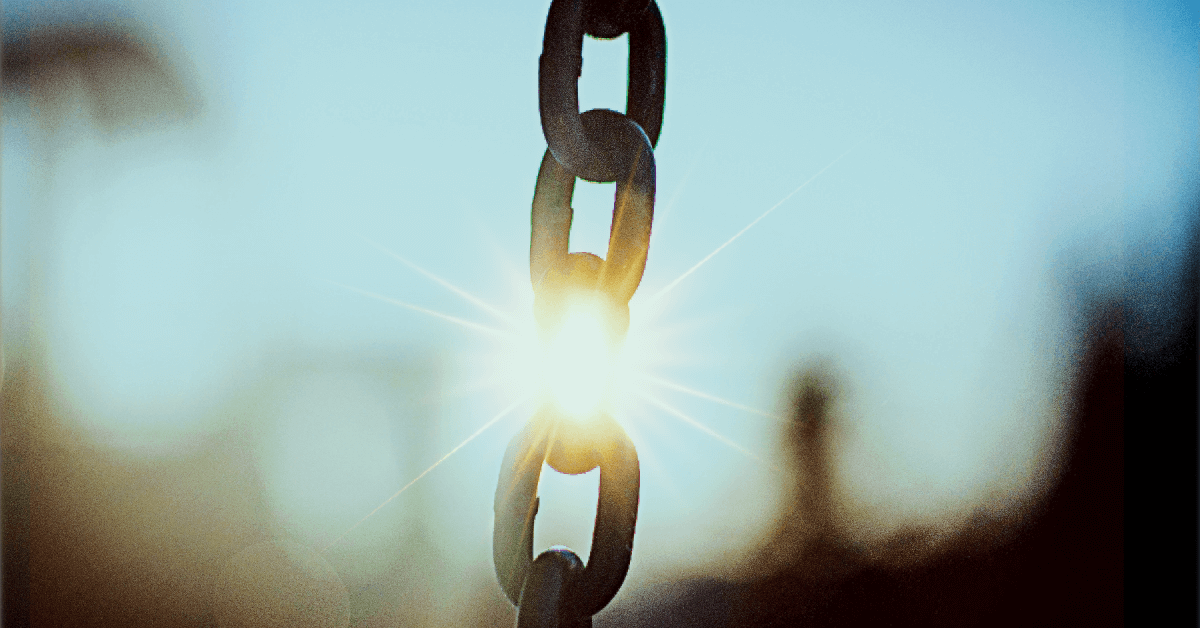
The heart of "Broken Chain" is its central image. A family is a chain: each link separate, each one joined to the others. When one link breaks, the whole chain feels it. Nothing hangs quite the same way any more.
It's a perfect picture of how grief feels in a family. The loss isn't only personal. It changes everyone's place. The person who always called on Sundays, who hosted the holidays, who knew the family stories, is gone, and everyone has to shift to fill the gap.
But the poem doesn't leave the chain broken. Its last turn is one of Christian hope: as each of us is called home in turn, the links join again. For readers who share that faith, it's a deep comfort. For those who don't, the image still points to something true: the bonds we made don't simply vanish.
Notice, too, how the poem keeps the dead person close. Love continues past death, part of us goes with them, and they stay at our side. Grief researchers have a name for this: "continuing bonds," the idea, set out by Dennis Klass and colleagues in the 1990s, that staying connected to someone who has died is a common and healthy part of grieving. Tranmer gets there in a few plain lines.
Why it works
"Broken Chain" is easy to read aloud, and that's a big part of its gift. Its short lines and steady rhymes give a shaky voice something to lean on at a service. You don't have to be a confident reader to get through it.
It's also written as "we," speaking to "you." The family speaks together, directly to the person who died. That makes it feel less like a poem about grief and more like a farewell the whole family can say at once.
And it's honest about the shock. It opens by admitting nobody knew this day was coming. If your loss was sudden, that first line can feel like someone finally said it out loud.
Interestingly, Tranmer has published two versions: the original, and a later "Revised by Author" version with slightly different wording in places. If you plan to print it, choose the version you prefer from his site and use it exactly as he wrote it.
How to use "Broken Chain" with care
Tranmer has been generous with this poem. His site says personal use is freely permitted, including reading it at funerals and printing it for personal keepsakes, as long as he's clearly credited as the author. Commercial use needs a written licence. Here's how to honour that and the person you're remembering.
- Credit him by name. On a memorial card, order of service or tribute, add "Ron Tranmer" under the poem. It takes one line.
- Copy it from the source. Take the text from his website rather than a screenshot or a forwarded message, so the words are exactly his.
- Read it slowly. If you're reading at a service, pause at the end of each verse. Let the last line about the chain linking again have a moment of silence after it.
- Pair it with a story. Before or after the poem, share one small memory of the person. The poem gives the shape; your story makes it theirs.
- Ask if it's commercial. If you're a funeral home, printer or business using it for profit, contact Ron Tranmer through his website about a licence.
Where to read more of Ron Tranmer
You can read "Broken Chain" in full, and both of its versions, on Ron Tranmer's website, along with hundreds of his other poems for sympathy, faith and family. His books are listed in the shop there too. If his site is slow to load, here is an archived copy of his poem page.
If the chain in your family has just broken, be patient with yourself. Grief takes the time it takes. Lean on the links that are still strong, and let them lean on you. We're thinking of you.
Lifeism shares ideas and practices for reflection. It is not medical, psychological or financial advice. Read our Disclaimer.