
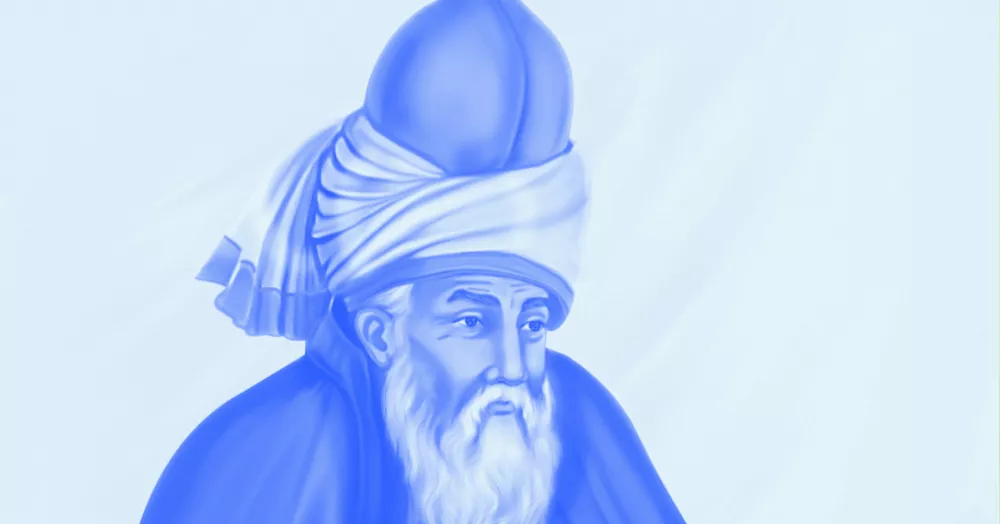
"A Moment of Happiness" is a short love poem by the 13th-century Persian poet Rumi, best known in English through Kabir Helminski's translation. It pictures two lovers sitting together on a verandah, so close they seem "apparently two, but one in soul," and it suggests that a love like that outlasts this world.
We've all had a moment like this, even if we didn't have the words for it. A calm evening, someone beside us, nothing special happening, and yet everything feels exactly right. Rumi wrote that moment down nearly 800 years ago, and it still sounds like it happened last week.
So let's sit with it. Here's who wrote it, who translated it, what it says, and how to carry a little of it into your own relationships.
The poem
The poem opens with the scene that gives it its name:
A moment of happiness,
you and I sitting on the verandah,
apparently two, but one in soul, you and I.
Rumi, "A Moment of Happiness," translated by Kabir Helminski, from Love Is a Stranger: Selected Lyric Poetry of Jelaluddin Rumi (Threshold Books, 1993; Shambhala, 2000).
From that gentle opening, the poem widens out. The two lovers feel the flow of life around them, in a garden full of birdsong. The stars look on. The pair become, in one of the poem's loveliest images, a thin crescent moon. They stop caring what anyone else thinks. Heaven itself seems to celebrate them. And the poem closes by imagining their togetherness carrying on, in this world and in another, timeless one.
Who was Rumi?
Jalal al-Din Rumi was born on 30 September 1207 in Central Asia and died on 17 December 1273 in Konya, in present-day Turkey. He was a Muslim scholar and teacher, and the Mevlevi Sufi order, known for its whirling ceremony, grew from his teaching. Many people still call him Mevlana or Mawlana, "our master."
The turning point of his life was meeting a wandering mystic, Shams of Tabriz. Their friendship was intense, and when Shams disappeared, Rumi's grief and longing poured out as lyric poems. These were collected as the Divan-e Shams-e Tabrizi. His other great work is the Masnavi, a long spiritual poem in six books.
That background matters for this poem. In Rumi's world, human love and the love of God were never far apart. A poem about two people on a verandah can also be a poem about the soul and the divine. You don't have to choose one reading. The poem has room for both.
Who translated this version?
Rumi wrote in Persian, so every English version is someone's translation, and translations of Rumi vary a lot. The version people know, with the verandah and the refrain "you and I," is by Kabir Helminski. It appears in his collection Love Is a Stranger: Selected Lyric Poetry of Jelaluddin Rumi, first published by Threshold Books in 1993 and reissued by Shambhala in 2000.
Helminski isn't only a translator. He's a shaikh of the Mevlevi order and, with Camille Helminski, directs the Threshold Society, so his English comes from inside the tradition Rumi founded. If you love this poem, his book is the place to read it in full, alongside many more of Rumi's lyric poems.
What the poem means
At its heart, "A Moment of Happiness" is about union. The phrase "apparently two, but one in soul" says it plainly: two bodies, one shared inner life. Anyone who has loved deeply knows the feeling of finishing someone's sentence, or understanding them without a word.
Look at how ordinary the setting is. No grand gesture, no wedding, no reunion at an airport. Just two people sitting on a verandah. Rumi is telling us that the deepest happiness often arrives in the plainest moments, if we're present enough to notice.
The crescent moon is worth pausing on. A crescent looks like a sliver, yet the whole moon is still there. It's a beautiful way to say that what others see of a couple is only a small part of what's really between them.
And then there's the word "unselfed." In the poem, the lovers aren't two egos negotiating. They've let go of the separate self for a while, which is exactly why gossip and idle opinions stop mattering. In Sufi terms, losing the small self is the doorway to something larger.
How the poem works
The engine of the poem is its refrain: "you and I." It returns again and again, like a heartbeat, until the two words start to feel like one. That repetition does what the poem describes. It joins the pair over and over until they can't be separated.
The images also move outward in a widening circle: the verandah, the garden, the birds, the stars, heaven, and finally a timeless land beyond this one. It's like a camera pulling back from two people on a porch to the whole of creation, and then beyond it. The love stays the same size the whole way. Everything else grows around it.
Notice the playfulness, too. Heaven's parrots celebrating with sugar is a funny, sweet, slightly wild image. Rumi's mysticism is never solemn for long. Joy, for him, is a spiritual state.
Bring a moment of happiness into your week
The poem asks for nothing complicated. It asks us to notice. Here are a few small ways to practise.
- Make your own verandah. Pick ten minutes this week to sit with someone you love, phones away, with no plan. A porch, a balcony, a kitchen table all count.
- Name the moment out loud. When you feel that simple rightness, say so: "This is nice." It turns a passing feeling into a shared memory.
- Let go of the audience. The lovers stop caring about idle talk. Notice one place where you're performing your relationship for others, and drop it for a day.
- Read it together. Read the full poem aloud with your partner, a friend or a family member, and ask each other which line you'd keep.
You don't need a perfect relationship to have a perfect moment. You just need to be there for it.
Where to read more
Read the complete poem, and many more of Rumi's love poems, in Kabir Helminski's Love Is a Stranger: Selected Lyric Poetry of Jelaluddin Rumi (Shambhala). You can learn more about Helminski and the Mevlevi tradition at the Threshold Society.
Somewhere this week there's a verandah waiting for you, and someone to sit beside. Go and find your moment. We hope it's a sweet one.
Lifeism shares ideas and practices for reflection. It is not medical, psychological or financial advice. Read our Disclaimer.