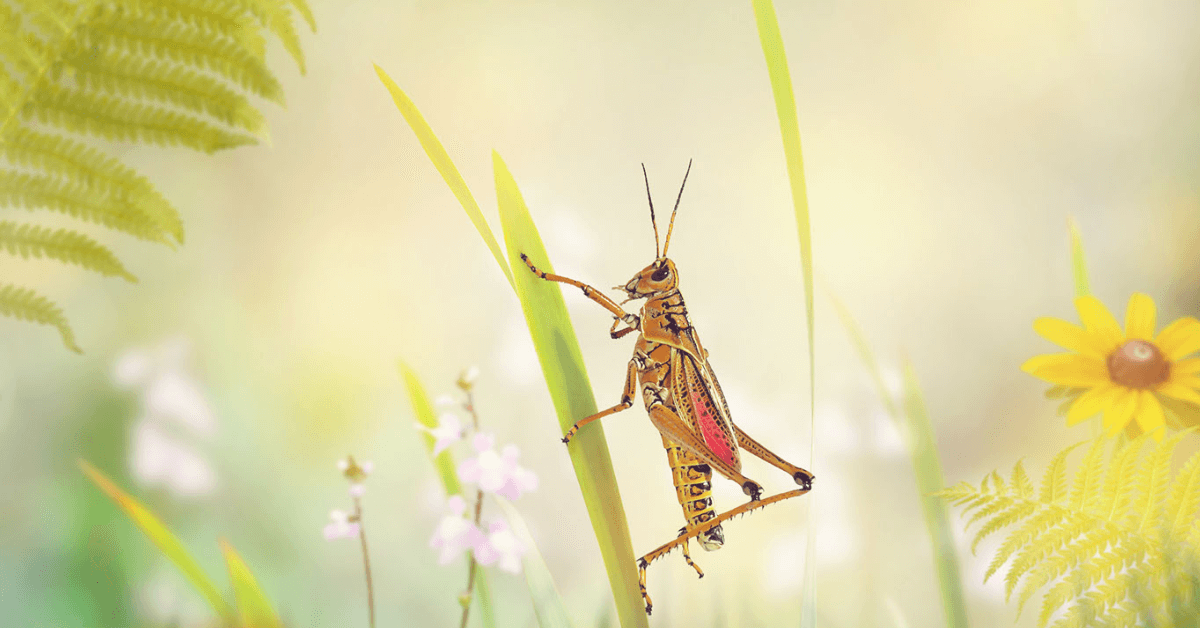
In most spiritual readings, a grasshopper is a sign to leap: trust your gut, take the chance you've been circling, and move forward even when you can't see where you'll land. A dead grasshopper is usually read as the other half of that message, a chapter closing so a new one can begin, and in nature it most often simply means the season is turning.
Many of us have a childhood memory of chasing grasshoppers through long grass. You'd crouch, cup your hands, and the thing would vanish in one impossible spring. It's a small creature that doesn't crawl or fly so much as launch, and that's probably why people all over the world have looked at it and seen something more.
So if one landed on your windowsill this week, or you found one lying still on the path and felt a strange little tug, you're not being silly. You're doing what humans have always done. Let's look at what the grasshopper has meant to different cultures, what it might mean to you, and what to actually do with that feeling.
What does a grasshopper mean spiritually?
The grasshopper is an old creature. Its ancestors go back about 250 million years, to the early Triassic period, so it has had plenty of time to collect meanings. In modern spiritual writing, the ones that come up again and again are luck, abundance, courage, intuition and taking a leap of faith.
But here's the honest part. Those meanings are beliefs that grew out of particular places and ways of life. In parts of China, the grasshopper's cousins were a wish for many children. In farming communities from the Bible to the North American plains, a swarm meant ruin. Same insect, opposite omens.
So take the meanings lightly. Before you read on, notice what you felt when you saw the grasshopper. Hopeful? Uneasy? Write that one word down. It'll matter more than anything on this page.
What does it mean when you see a grasshopper?
If you believe in signs, a grasshopper crossing your path is usually read in one of four ways. You'll probably know which one is yours the moment you read it.
It's time to take the leap
This is the big one. A large grasshopper can jump about 20 times its own body length without opening its wings. It doesn't inch towards the thing. It commits.
If there's something you've been planning for months, the course, the conversation, the move, consider this your nudge. Pick the smallest real step towards it and do it today. Send the email. Book the call. A leap is just one decision you stop postponing. And if you need a push, here's why you miss 100% of the shots you don't take.
Trust your gut
Some days our inner voice says something that makes no logical sense, and we talk ourselves out of it. Many people read a grasshopper as a reminder to stop doing that and listen.
Try this. Write down the choice you're facing, then write the answer your gut gave you in the first three seconds. You don't have to obey it. Just stop pretending you didn't hear it.
Stop playing small
It happens slowly. We get busy with to-do lists and errands and sensible plans, and one day we notice we've stopped chasing anything we actually want. We're getting through the week, not living it.
Here's a striking image from the Bible: scouts returning from Canaan say of the giants they saw, "we were in our own sight as grasshoppers" (Numbers 13:33). They felt small, so they acted small. If that's you lately, take ten minutes this week and list three dreams you shelved. Circle one. That's the one you're going to give an hour to.
An opportunity is close
In many traditions the grasshopper is a good-luck sign, so some people take a sighting to mean good news or a fresh opportunity is on its way. Luck, though, tends to favor the person who's ready for it.
So get ready. Update the resume, finish the draft, tidy the portfolio. If the opportunity comes, you'll be able to say yes. If it doesn't, you'll still be further along than you were.
What does a dead grasshopper mean?
There's no single old tradition that assigns a meaning to a dead grasshopper. Modern spiritual readers usually see it as an ending: a phase, a habit or a relationship that has run its course, clearing space for something new. It's the leap's calmer twin. Before you jump, you have to let go of where you were standing.
There's also a plain, grounded reading, and it's worth knowing. Most grasshoppers live for a single season. Utah State University Extension notes that most species have one generation a year, with eggs laid in summer and autumn that hatch the following spring, and Colorado State University Extension explains that species which overwinter as eggs die out in late summer and early autumn. So a dead grasshopper in September is, first of all, a sign that summer is done.
And honestly, that's a meaningful thought on its own. Seasons end so new ones can start. If finding it stirred something, ask yourself one question: what in my life has already finished, that I'm still carrying around? Name it, and choose one small way to close it, a message, a clear-out, a goodbye. This piece on why starting over can be a good thing might help.
What do different grasshopper colors mean?
Most grasshoppers are shades of green and brown, though you'll see others in dreams and now and then in real life. These color meanings come from modern spiritual writing rather than any ancient tradition, so treat them as prompts for reflection, not predictions.
- Green grasshopper: health, growth and a new phase of life. Ask: what's starting to grow for me right now?
- Brown grasshopper: being grounded, finding your roots and building deeper relationships. Ask: who do I want to be closer to?
- Black grasshopper: your purpose, and a nudge not to give up on your dreams. Ask: what would I regret not trying?
- White grasshopper: self-love and self-care. Ask: what do I need that I keep putting last?
- Red grasshopper: letting go of old emotions and making room for new desires. Ask: what feeling have I outgrown?
Pick the question that fits the grasshopper you saw and give it five minutes in a notebook.
Is the grasshopper your spirit animal?
A lot of people use "spirit animal" or "totem" loosely for a creature they feel drawn to. The ideas come from specific Indigenous traditions, so it's worth using them with some respect. In that looser modern sense, people who feel a bond with the grasshopper often describe themselves as instinctive, adaptable, spontaneous and quick to chase a dream.
How would you know? You'd feel it. Grasshoppers might seem to turn up at turning points in your life, or you simply find yourself drawn to them. Some people get a grasshopper tattoo to keep that reminder close.
You don't need ink, though. If the grasshopper means something to you, let it stand for one quality you want more of, maybe courage, maybe spontaneity, and put a small picture of one where you'll see it each morning. Let it ask you, every day, "What's your leap today?"
What does the grasshopper mean in Chinese and Japanese tradition?
In China, one of the oldest poems in the Classic of Poetry (the Shijing), "Zhongsi", uses a swarming grasshopper-like insect as a blessing for many children and grandchildren. That symbol of a big, thriving family runs deep. There's even a Zhongsi Gate in Beijing's Forbidden City, facing the Gate of a Hundred Children, and the famous Jadeite Cabbage in Taipei's National Palace Museum has a tiny locust carved into its leaves, often read as that same wish for many children.
Singing insects mattered too. In the Qing court, katydids were raised for their song, and in Japan the suzumushi, or bell cricket, a close cousin of the grasshopper, is still often kept as a pet for its chiming call. In both places the meaning is about home, luck and listening.
Try borrowing that. This week, sit outside at dusk for five minutes and just listen. Name every sound you can hear. It's a tiny practice, but it brings you back to where you are.
What did the grasshopper mean to the ancient Greeks?
In Archaic Athens, the grasshopper was a symbol of the city itself. Native Athenians wore golden grasshopper brooches to show their family had always belonged to that land. To them it meant roots and belonging.
Greek myth also gives us the sad, beautiful story of Eos, goddess of the dawn, and her human lover Tithonus. Eos asked Zeus to make Tithonus immortal, but forgot to ask that he stay young. He kept ageing and shrinking until, in later tellings, he became a cicada. The Greek word, tettix, means cicada but is often translated as grasshopper, which is why you'll see the story told both ways.
There's a lesson tucked in there about asking for the right thing. Before your next big wish or goal, write it down and then ask, "And what else would I need for this to actually be good?" Eos forgot that second question.
What does the grasshopper mean in the Bible?
In the Bible, grasshoppers and locusts usually stand for numbers too great to count, and often for destruction. In Judges, the Midianite raiders who stripped Israel's harvests "came as grasshoppers for multitude; for both they and their camels were without number: and they entered into the land to destroy it" (Judges 6:5).
The best-known example is the eighth of the plagues of Egypt in the book of Exodus, when locusts cover the ground and eat every growing thing. Locusts, by the way, are simply certain grasshopper species in their swarming phase. Even an Egyptian pharaoh, Ramesses II, compared an enemy army to locusts in their multitude.
So if you were raised with these stories and a grasshopper makes you uneasy, that's understandable. You can honor the story and still choose a different meaning today. What feels like a swarm in your life right now? Write down the one thing eating most of your time and energy, and decide on one boundary around it.
What does the grasshopper mean in Native American stories?
There's no single Native American meaning, because there are hundreds of nations with their own traditions. According to Native Languages of the Americas, farming tribes, whose crops grasshoppers could destroy, often gave them character flaws like greed or carelessness, and linked them with bad luck. Among the Hopi, grasshoppers were sometimes said to bite the noses of children who disobeyed their elders.
Hunter-gatherer peoples, on the other hand, were rarely troubled by grasshoppers, and their stories don't carry that negative weight. In some tribes, grasshoppers were even said to predict or influence the weather. There are origin stories too, like an Abenaki legend of how grasshoppers were first made, and a Menominee tale in which the hero Manabush punishes a stingy Grasshopper who hoards tobacco.
The takeaway is a useful one for us: meaning follows how people live. Ask yourself what the grasshopper stands for in your life as it actually is, not as someone else's tradition says it should.
So, what should a grasshopper mean to you?
At Lifeism, we often lean on the psychologist Alfred Adler, who argued that situations don't hand us their meaning. We give it to them, and that meaning then shapes us. A grasshopper meant a good harvest to one farmer and a ruined one to another. Same insect. Different lives.
Most of us aren't farmers anymore, and a grasshopper on the porch won't change our fortunes. But the meaning we choose can change what we do next. If believing it's a sign to leap gets you to finally make that call, the belief has done something real. That's a choice, and it's yours, much like the meaning people find in a monarch butterfly.
So here's your one action. Ask, "Which belief will serve me better?" and choose that one on purpose. And if an old belief isn't helping you anymore, you're allowed to put it down.
We believe the small things that stop us in our tracks are worth a second look, because the pause gives us a chance to choose our next step. So the next time a grasshopper lands near you, take the hint and leap.
Have you had a grasshopper turn up at a big moment in your life? Tell us about it in the comments. We'd love to hear.
Lifeism shares ideas and practices for reflection. It is not medical, psychological or financial advice. Read our Disclaimer.